News
Well, after some thirty-five stops across the United States, Morocco, the U.K., and Australia, I can finally say that my book tour for The Dream Hotel is done. Phew! I’ve tried to post pictures on my social media along the way, but mostly I just tried to be present in the moment.
Foreign editions have now come out in Germany (Das Dream Hotel), Italy (Il Dream Hotel), Brazil (Os Hotel Dos Sonhos), and Hungary (Álom Hotel.) More translations are underway and others are under contract.
The big news is that the paperback edition is coming June 30 from Vintage. I will be launching it at Vroman’s in Pasadena that day. Here is the gorgeous cover art from designer Mark Abrams.

I love, love, love a good paperback. So portable, so much less expensive. If you’ve been waiting to read The Dream Hotel, talk about it with your book group, or assign it in one of your classes, now’s your chance. And, of course, you can get the print or audio edition for FREE from your local library. Libraries are small miracles.
I hope you all have a great summer! If you’d like to book me to talk to your class or book group this fall, please reach out to my speaking agent.
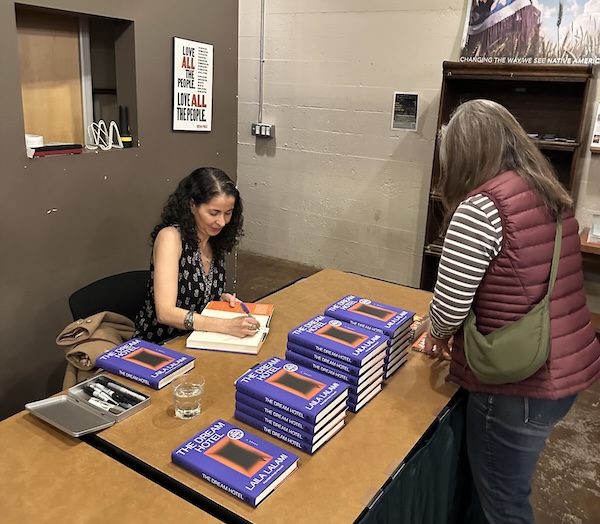
The Dream Hotel had a dream launch, much to my relief and delight. It received excellent reviews, including in the New Yorker, the Los Angeles Times, the Boston Globe, NPR’s Fresh Air, Vulture, the Guardian, and the Irish Times. The Washington Post Book World put the book on its cover, with a review by Francine Prose. In March, Harper’s published an excerpt from it. The Economist named it one of the best novels of the year so far. And it was longlisted for the Women’s Prize (a cherry on the proverbial cake!)
During the promotional tour for the novel, I had the enormous pleasure of being in conversation with writers I admire, and hearing directly from readers. One word that came up a lot during our discussions was “prescient,” so I wrote about the predictive power of speculative fiction for The Atlantic. (Spoiler alert: it’s more a reflection of the present than any kind of prophecy.)
I also had a chance to talk about The Dream Hotel on several shows and podcasts, including NBC’s Today show, NPR’s All Things Considered, B&N’s Poured Over podcast, CBC’s Bookends with Mattea Roach, and KQED’s Forum with Mina Kim. Print interviews appeared in People, San Francisco Chronicle, Christian Science Monitor, and World Literature Today.
I just wrapped up all my events for spring, but I will be back on the road in late August. Please visit the events page for more details. International editions of The Dream Hotel are forthcoming in German, Spanish, Ukrainian, Russian, Italian, Portuguese, and Turkish.
That’s all the news I have! I’m going to retreat into my writing cave again, but I do want to say thank you to all the readers, critics, librarians, and booksellers who’ve engaged with The Dream Hotel, to all the friends who came out to support me on tour, and to my fantastic team at Pantheon for all their dedication and hard work. I don’t take any of it for granted.

If you have a smartphone, you’ll no doubt have had a moment when you realized that it knew more about you than you’d ever expected. Even though you’ve agreed to the terms of service, it still feels like a terrible violation of privacy. I wanted to push this technological surveillance to the limit in my new novel, The Dream Hotel. The story follows Sara Hussein, a museum archivist and busy mom who returns home from a conference abroad to find herself accused of a crime she has yet to commit. Using data from her dreams, a government algorithm has determined that she is at risk of harming her husband. She is taken to a retention center where she is held with other dreamers, all of whom are accused of crimes. If Sara is to regain her freedom, she will have to find ways to confront and resist this surveillance.
The novel will be out in the U.S. and the U.K. on March 4, with several translations to follow. Is it a departure from my previous books? Yes. But also… no. The setting is unusual for me because I had to create a believable near future, but I’m still exploring some of the ideas about identity, power, and belonging that I’ve written about in my previous work.
The Dream Hotel has received starred reviews from Kirkus, Publishers’ Weekly, and Booklist. It has been featured in more than a dozen spring 2025 preview lists, including those of Time, People, the Washington Post, Marie Claire, New Scientist, and Esquire. And it has received advance praise from Rumaan Alam (“extraordinary”), Jennifer Egan (“Kafkaesque”), Kelly Link (“thrilling”), among others.
As you know, pre-orders are crucial to the success of a book, so if The Dream Hotel sounds like something you might want to read (or listen to!), please preorder a copy from your local bookstore. If you’d like a signed/personalized copy, this RJ Julia Bookstore will be happy to take your order before February 28.
I’ve set this post to publish a couple of weeks before release date, because I want to be present and able to enjoy the moment. The pandemic prevented me from touring my last book, and I’m really looking forward to seeing you in person at one of my upcoming events. Come say hi!
One morning in 2013, I picked up my phone when I woke up and noticed a Google notification that said, “If you leave right now, you will make it to YogaWorks at 7.28.” I had never told Google what day of the week, what time of day, or even that I went to yoga, but the company had tracked my movements and in time its algorithms had learned my schedule and habits.
Not long after, the magazine Slate reported that Facebook keeps track of everything its users do on the app, including their keystrokes. I realized that if Facebook has a record of unposted comments, in effect it has access to our unvoiced opinions, which is to say our thoughts. I remember I turned to my husband and said, “Pretty soon the only privacy we will have will be in our dreams.” And then I thought, wait. What if someday even dreams are monitored?
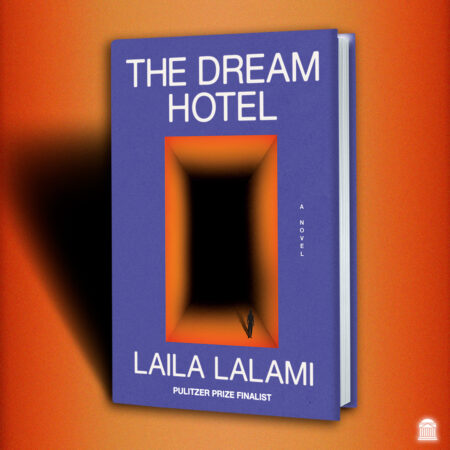
I started exploring this idea in novel form, but after about seventy pages I hit a road block and decided to focus on a different novel I’d been working on, a family story set in the Mojave. Still, the idea of dream surveillance stayed in the back of my mind and, after The Other Americans was published, I returned to it, working slowly through the early days of the pandemic. I completed The Dream Hotel a few months ago and it is now in production, with this striking cover from the incomparable Jack Smyth.
The Dream Hotel is set in Los Angeles in the near future and follows a thirty-eight-year old archivist. Sara leads what is by all appearances an ordinary life: she works at a local museum, has a husband and twin toddlers, and spends her free time hiking or backpacking. One day, on her return home from a conference abroad, agents from the Risk Assessment Administration pull her aside and inform her that she will soon commit a crime.
Using data from her dreams, the RAA’s algorithm has determined that Sara is at imminent risk of harming the person she loves most: her husband. For his safety, she must be kept under observation for twenty-one days. The agents transfer Sara to a retention center, where she is held with other dreamers, all of them people trying to prove their innocence from different crimes. With every deviation from the strict and ever-shifting rules of the facility, their stay is extended.
Months pass and Sara seems no closer to release. Then one day, a new resident arrives, disrupting the order of the facility and leading Sara on a collision course with the very companies that have deprived her of her freedom.
The Dream Hotel is set for release in the U.S. in March 2025 with Pantheon Books. Hop on over to People magazine for more details about the story and an exclusive excerpt from the first chapter!
And now, a humble request. As you all know, pre-orders are crucial to the launch of a book. If the description above appeals to you, please preorder the book now from your favorite retailer.

And now, some news before I go on summer hiatus!
It was a pleasure to guest-edit the spring issue of the literary magazine Ploughshares, with poems by Mosab Abu Toha, Khaled Mattawa, January Gill O’Neil, Rob Shapiro, Connor Watkins-Xu; excerpts from forthcoming novels by Jane Smiley and Nina McConigley; short fiction from Emily Doyle, Francisco Goldman, Jamila Minnicks, and Tommy Orange; and essays by Hannah Roberts, Tochi Onyebuchi, and Farah Abdessamad, among many others. You can buy a copy of the magazine from the Ploughshares website, or find it in your local library or independent bookstore.
Late last spring, I sat down with Dylan Cuellar and Kassia Osset, hosts of the Unburied Books podcast, to discuss Tayeb Salih’s classic novel Season of Migration to the North, translated from the Arabic by Denys Johnson-Davies. It’s one of those books that gets pressed into new hands by devoted fans like me, and I never tire of talking about it. (Or writing about it! I wrote the introduction for the NYRB Classics edition of the book.) If you like stories of departures and returns, strong narrators, and doomed love affairs, you will love this one.
I also had the great honor to serve on the jury for the 2024 Carol Shields Prize, along with Jen Sookfong Lee, Claire Messud, Dolen Perkins-Valdez, and Eden Robinson. This (newish) prize aims to radically transform the economic circumstances of women and nonbinary writers by awarding a significant amount of money to the winner ($150,000) and a fairly substantial amount to the finalists as well. The jury spent about twelve months reading and discussing hundreds of entries before deciding on the finalists: Birnam Wood by Eleanor Catton, Daughter by Claudia Dey, Coleman Hill by Kim Coleman-Foote, Brotherless Night by V.V. Ganeshananthan, and A History of Burning by Janika Oza. The winner, announced at a ceremony in Toronto in May was Brotherless Night by V.V. (Sugi) Ganeshananthan, a searing novel set during the early years of Sri Lanka’s civil war.