News

When I heard that Ralph Nader had written a book called Only the Super-Rich Can Save Us, I thought, based on its title, that it had to be some sort of satire. But, according to the publicity materials posted by Nader’s publisher, Seven Stories Press, the book is about a group of fabulously wealthy individuals who decide that it is time to make good on the promise of “liberty and justice for all.” Led by the billionaire Warren Buffet, they start working for the common good: workers’ unions, clean elections, human rights, and so on. So Only the Super-Rich Can Save Us is really a fantasy, but its sheer length (780 pages!) causes NPR’s Alan Cheuse to call it “an unconscionable attack on America’s trees.”
Perhaps anticipating the confusion, Nader has said that this book is not a novel. It is “a fictional vision that could become a new reality.” Me, I’m just curious how he plans on getting those super-rich to read his book.

The Dutch translation of my novel, Secret Son, is being published this week in Amsterdam, under the title De Geheime Zoon. Since this blog has a fair number of Dutch readers, I thought I’d mention this. Go out and get it! I won’t be traveling to the Netherlands this time, but I hope that readers who read the book will report back with their thoughts.
One of the books I’m most excited about this fall is Chinua Achebe’s The Education of a British-Protected Child, a collection of essays about his life in Nigeria and America. It’s being published this week and I believe this is his first book since Home and Exile, which was based on lectures he gave at Harvard. There is some coverage at Reuters, though it follows the usual, predictable track: famous novelist, Things Fall Apart, grandfather of African literature, etc.
This week, the American Library Association observes Banned Books Week, an effort at raising awareness about censorship and the freedom to read. Many books have been challenged, or entirely banned, over the years in the United States, including, at various times, Beloved, The Great Gatsby, Catch 22, The Grapes of Wrath, and (my personal favorite) The American Heritage Dictionary, which was removed from a Missouri library in 1978 because it contained “objectionable” words. Interestingly, the most common initiators of book challenges are parents. You can find a list of classics that have been challenged or banned over the years here.
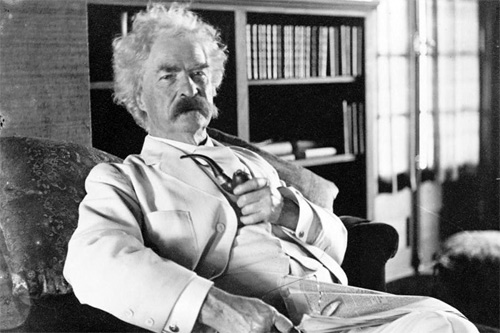
From the essay “Corn-Pone Opinions,” which Twain wrote in 1901 but didn’t publish during his lifetime. It first appeared in print in 1923.
Men think they think upon great political questions, and they do; but they think with their party, not independently; they read its literature, but not that of the other side; they arrive at convictions, but they are drawn from a partial view of the matter in hand and are of no particular value. They swarm with their party, they feel with their party, they are happy in their party’s approval; and where the party leads they will follow, whether for right and honor, or through blood and dirt and a mush of mutilated morals.
In our late canvass half of the nation passionately believed that in silver lay salvation, the other half as passionately believed that that way lay destruction. Do you believe that a tenth part of the people, on either side, had any rational excuse for having an opinion about the matter at all? I studied that mighty question to the bottom — came out empty. Half of our people passionately believe in high tariff, the other half believe otherwise. Does this mean study and examination, or only feeling? The latter, I think. I have deeply studied that question, too — and didn’t arrive. We all do no end of feeling, and we mistake it for thinking. And out of it we get an aggregation which we consider a boon. Its name is Public Opinion. It is held in reverence. It settles everything. Some think it the Voice of God.
You can find the essay online here.
Photo Credit: LAT.