
I’ve tried to avoid the trailer of the film adaptation of David Mitchell’s Cloud Atlas. (I mean: the Wachowskis? Tom Hanks? Hugo Weaving as an Asian man? Huh?) But last week I gave in and watched it and now I’m curious to see it. The novel has six interweaving story lines, although ‘interweaving’ isn’t quite the right word to describe what Mitchell does: multiple voices, multiple styles, multiple genres, multiple eras, all of them held together with a fragile thread—the transmigration of souls.
The passage below, about life, death and rebirth, and which I can hardly ever re-read without having a knot in my throat, is from the Frobisher story, “Letters from Zedelghem.”
Luger here. Thirteen minutes to go. Feel trepidation, naturally, but my love of this coda is stronger. An electrical thrill that, like Adrian, I know I am to die. Pride, that I shall see it through. Certainties. Strip back the beliefs pasted on by governesses, schools and states, you find indelible truths at one’s core. Rome’ll decline and fall again. Cortés’ll lay Tenochtitlán to waste again, and later, Ewing will sail again, Adrian’ll be blown to pieces again, you and I’ll sleep under Corsican stars again, I’ll come to Bruges again, fall in and out of love with Eva again, you’ll read this letter again, the sun’ll grow cold again. Nietzsche’s gramophone record. When it ends, the Old One plays it again, for an eternity of eternities.
Time cannot permeate this sabbatical. We do not stay dead long. Once my Luger let me go, my birth, next time around, will be upon me in a heartbeat. Thirteen years from now we’ll meet again at Gresham, ten years later I’ll be back in this same room, holding this same gun, composing this same letter, my resolution as perfect as my many-headed sextet. Such elegant certainties comfort me at this quiet hour.
More on David Mitchell here.
Photo credit: The Guardian.
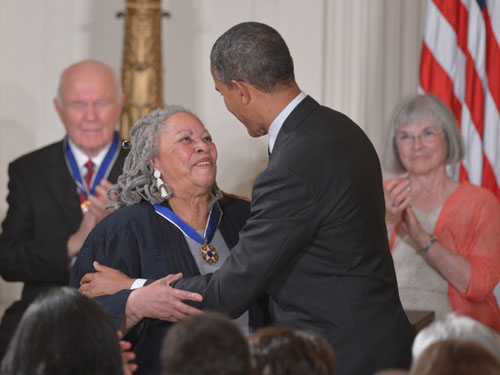
Earlier this week, Toni Morrison was awarded the Presidential Medal of Freedom at a ceremony in the White House. In his remarks, Barack Obama mentioned that he read Song of Solomon not just to learn how to write, but also “how to be.” Song of Solomon is one of my favorite of Morrison’s novels. And it struck me that it often uses repetition as a stylistic device, which is something that Obama does a lot in his speeches. So I thought I’d excerpt two short paragraphs from the book, both of which use repetition masterfully. Here is a passage from early on in the book, describing Macon Dead’s car:
In 1936 there were very few among them who lived as well as Macon Dead. Others watched the family gliding by with a tiny bit of jealousy and a whole lot of amusement, for Macon’s wide green Packard belied what they thought a car was for. He never went over twenty miles an hour, never gunned his engine, never stayed in first gear for a block or two to give pedestrians a thrill. He never had a blown tire, never ran out of gas and needed twelve grinning raggle-tailed boys to help him push it up a hill or over to a curb. No rope ever held the door to its frame, and no teenagers leaped on his running board for a lift down the street. He hailed no one and no one hailed him. There was never a sudden braking and backing up to shout or laugh with a friend. No beer bottles or ice cream cones poked from the open windows. Nor did a baby boy stand up to pee out of them. He never let rain fall on it if he could help it and he walked to Sonny’s Shop–taking the car out only on these occasions. What’s more, they doubted that he had ever taken a woman into the back seat, because rumor was that he went to “bad houses” or lay, sometimes, with a slack or lonely female tenant. Other than the bright and roving eyes of Magdalene called Lena and First Corinthians, the Packard had no real lived life at all. So they called it Macon Dead’s hearse.
The repetition of the adverb “never” obviously emphasizes how little use Macon Dead makes of the car, but it also informs us about the multiple uses other people in his community might have made of it. Halfway through, the switch from “never” to “no” highlights the fact that the car, like its owner, lacks a certain essence, a kind of vitality. All of which leads us to its funny, and appropriate, nickname: “Macon Dead’s hearse.”
Now, toward the end of the novel, Macon Dead’s son returns to Montour County to learn more about his deceased grandfather, who was also named Macon Dead. And, here, Toni Morrison uses the same device, but for the opposite effect. This is a description of the farm that the elder Macon owned:
A farm that colored their lives like a paintbrush and spoke to them like a sermon. “You see?” the farm said to them. “See? See what you can do? Never mind you can’t tell one letter from another, never mind you born a slave, never mind you lose your name, never mind your daddy dead, never mind nothing. Here, this here, is what a man can do if he puts his mind to it and his back in it. Stop sniveling,” it said. “Stop picking around the edges of the world. Take advantage, and if you can’t take advantage, take disadvantage. We live here. On this planet, in this nation, in this county right here. Nowhere else! We got a home in this rock, don’t you see! Nobody starving in my home; nobody crying in my home, and if I got a home, you got one too! Grab it. Grab this land! Take it, hold it, my brothers, make it, my brothers, shake it, squeeze it, turn it, twist it, beat it, kick it, kiss it, whip it, stomp it, dig it, plow it, seed it, reap it, rent it, buy it, sell it, own it, build it, multiply it, and pass it on–can you hear me? Pass it on!”
Though the sentence starts familiarly with the repetition of “never,” it doesn’t speak of what never happens, but of what people should never mind happening. It isn’t about absence, it’s about presence and power. And then other syntactic forms are repeated: the demonstrative (“this nation, this county”) and the imperative (“take it, hold it”), for instance, to emphasize that power. The beauty of the two passages is how, through the description of two simple possessions, the car and the farm, we get two portraits of two very different Macon Deads.
Photo credit: Mandel Ngan/AFP/Getty Images

Five years ago this week, Moroccan literature lost one of its greats, the novelist Driss Chraïbi. I wanted to post a short excerpt from Le Passé Simple, his first novel and perhaps the most widely studied of his works. It tells the story of a young man who violently rebels against the edicts of his father, a tea merchant from Mazagan. When it was published in 1954, Le Passé Simple created a huge controversy in Morocco. The country was still in the midst of its struggle for independence. Many Moroccan intellectuals didn’t look kindly on a book that virulently criticizes traditional Moroccan modes of living and ends with the main character leaving for France, and, as a final act of goodbye, uses the bathroom on the airplane, in the hope that “every drop falls on the heads of those I know well, who know me well, and whom I despise.” In France, the reaction was quite the opposite; the book was quite well reviewed, perhaps serving as “proof” that Morocco needed France’s civilizing influence.
But Le Passé Simple is much more than a simple cry of revolt. Yes, it is full of anger at the father character (referred to throughout as “Le Seigneur,” that is, “The Lord”); at the treatment of women; at the teaching in Quranic schools; at the hypocrisy of Moroccan society; and so on. But there are also moments of tenderness for both the father and the mother, for books, for the joys of teenage life. There is a strong emphasis on the powerlessness of silence and fear–the mother is silent, the children are silent–and so, necessarily, on the power of the word. It’s a beautifully written novel, with moments of great lyricism.
Un après midi, j’ai fait l’école buissonnière sans m’en rendre compte. J’ai erré dans les rues , siffloté avec les oiseaux, suivi le vol des nuages. Finalement, je me suis perdu. Une vieille femme m’a rencontré, m’a embrassé, m’a donné deux sous. J’ai mis la pièce dans une boîte d’allumettes vide ramassée quelque part.
Vers le soir, je vis une silhouette connue qui venait à ma rencontre à grandes enjambées. Ce n’était autre que mon digne et respecté père. Le règlement de compte, entre lui et moi, se fit, à mes dépens, en trois actes.
ACTE Ier: Nous passâmes rassurer le maître d’école. Afin de profiter d’une si bonne occasion de se démontrer le dévouement qu’il s’acharnaient à avoir l’un pour l’autre (selon les traités verbaux jurés bilatéralement le jour de mon inscription) mon père me bascula en l’air et le maître cingla la plante de mes pieds une bonne centaine de fois. Nous prîmes Camel au passage et allâmes tous trois a la maison.
ACTE II: Rentrés chez nous, après maintes explications, les salamalecs et pleurs de soulagement de ma mère, la même scène que tout à l’heure recommença, mais avec un léger correctif. Ce fut maman, trop heureuse de voir, qui maintint mes jambes et mon père qui fit tournoyer le bâton. Une demi-heure durant.
ACTE III: Les pieds en sang, je me jette dans les bras de ma mère, largement ouverts et consolateurs. Mon père n’admet pas de faiblesse, nous corrige tous en conséquence, et sort en claquant les portes. Nous restons, là, Camel, ma mère et moi, à nous lamenter comme des pleureuses juives.
EPILOGUE: Plus tard, je me souviens, je souris, je pêche dans ma poche la boîte d’allumettes, l’ouvre et montre ce qu’elle contient. J’ai quand même gagné deux sous dans ma journée.Maman les serre précieusement dans sa ceinture et m’embrasse.
I don’t own an English translation of the book (and I believe the one that was published some years ago by Counterpoint is out of print.) But here is my translation of the passage, for your enjoyment:
One afternoon, I skipped school, without realizing it. I wandered in the streets, whistled away with the birds, followed the flight of the clouds. Eventually, I got lost. An old woman saw me, kissed me, gave me two cents. I put the coin in a matchbox I picked up somewhere.
Toward evening, I saw a familiar figure coming toward me in large strides. It was none other than my dignified and respected father. The settling of accounts, between us, was done at my expense in three acts:
ACT I: We stopped by to reassure the schoolteacher. My father and the teacher used this opportunity to demonstrate the devotion they continued to have for one another (according to the verbal treaties sworn bilaterally on the day of my registration). My father tipped me up and the teacher whipped the soles of my feet a good hundred times. Then we picked up Kamal and went all three of us to the house.
ACT II: Once at home, after many salams, explanations, and cries of relief from my mother, the same scene unfolded anew, but with a slight change. It was my mother, too happy to see me, who held my legs and my father who used the stick. For half an hour.
ACT III: My feet bloody, I throw my self in my mother’s arms, open and consoling. My father does not admit a weakness, and therefore corrects all of us by leaving, slamming the doors behind him. We remain there, Kamal, my mother and me, moaning like Jewish funeral criers.
EPILOGUE: Later, I remember, I smile, I fish out of my pocket the matchbox, open it and show what it contains. I have, after all, earned two cents that day. Maman carefully ties them inside her belt and kisses me.
Chraibi lived in France and didn’t return to Morocco for many, many years. But he wrote other novels; Morocco got its independence; life went on. When he returned in early 1985, attitudes, too, had changed. University and high school students, many of whom were engaged in organizations that opposed the regime, had a completely different attitude to his work. (The influential magazine Souffles defended his work in a long article, too. ) In the end, he became the prodigal son.
Photo credit: MarocCulture

Yesterday was the start of the winter quarter at UC, and, as a warm-up exercise for my first class, I used this writing prompt: “an affair has been discovered.” The point is to get students to think about who is telling the story (the cheater? the cheated-upon, the cheated-with?), the details of the discovery (how was the affair revealed? a nosey neighbor? a jealous husband?), the purpose of the story (is it a simple confession? a plea for forgiveness? a justification? a piece of gossip one character shares with another?), and its intended recipient (a priest? a divorce lawyer? one of the people involved in the affair?). These kinds of choices can have a significant effect on the shape of the narrative. A great example is Junot Díaz’s story “The Sun, The Moon, The Stars”:
I’m not a bad guy. I know how that sounds—defensive, unscrupulous—but it’s true. I’m like everybody else: weak, full of mistakes, but basically good. Magdalena disagrees. She considers me a typical Dominican man: a sucio, an asshole. See, many months ago, when Magda was still my girl, when I didn’t have to be careful about almost everything, I cheated on her with this chick who had tons of eighties freestyle hair. Didn’t tell Magda about it, either. You know how it is. A smelly bone like that, better off buried in the back yard of your life. Magda only found out because homegirl wrote her a fucking letter. And the letter had details. Shit you wouldn’t even tell your boys drunk.
The thing is, that particular bit of stupidity had been over for months. Me and Magda were on an upswing. We weren’t as distant as we’d been the winter I was cheating. The freeze was over. She was coming over to my place and instead of us hanging with my knucklehead boys—me smoking, her bored out of her skull—we were seeing movies. Driving out to different places to eat. Even caught a play at the Crossroads and I took her picture with some bigwig black playwrights, pictures where she’s seen smiling so much you’d think her wide-ass mouth was going to unhinge. We were a couple again. Visiting each other’s family on the weekends. Eating breakfast at diners hours before anybody else was up, rummaging through the New Brunswick library together, the one Carnegie built with his guilt money. A nice rhythm we had going. But then the Letter hits like a Star Trek grenade and detonates everything, past, present, future. Suddenly her folks want to kill me. It don’t matter that I helped them with their taxes two years running or that I mow their lawn. Her father, who used to treat me like his hijo, calls me an asshole on the phone. “You no deserve I speak to you in Spanish,” he says. I see one of Magda’s girlfriends at the Woodbridge Mall—Claribel, the ecuatoriana with the biology degree and the chinita eyes—and she treats me like I ate somebody’s kid.
You don’t even want to hear how it went down with Magda. Like a five-train collision. She threw Cassandra’s letter at me—it missed and landed under a Volvo—and then she sat down on the curb and started hyperventilating. “Oh, God,” she wailed. “Oh, my God.”
This is when boys claim they would have pulled a Total Fucking Denial. Cassandra who? I was too sick to my stomach even to try. I sat down next to her, grabbed her flailing arms, and said some dumb shit like “You have to listen to me, Magda. Or you won’t understand.”
Here, the narrator begins with a pre-emptive defense (“I’m not a bad guy”). But he is aware that this defense itself might be incriminating (“I know how that sounds”), so he provides some justification for his actions as well (“I’m weak.” “I”m like everybody else.”) Then he gives his girlfriend’s opinion, which he ties to a stereotypical view of all Dominican men—a clever way of giving us Magdalena’s side of the story while also retaining our sympathy. This very delicate balance is maintained for the remainder of the story, when the narrator, Yunior, takes Magdalena with him to Santo Domingo, where they try to patch up their relationship and where, of course, nothing goes as planned.
The story originally appeared in The New Yorker and was anthologized in Best American Stories 1999.
Photo credit: Blogamole.